Product Guides
The Ultimate Guide to E-File Bits: Choosing, Using & Mastering Nail Drill Bits Like a Pro
Electric nail files, commonly known as e-files, have become an essential part of the professional nail technician’s toolkit. But an e-file is only as effective as the bit fitted to the handpiece.
Whether you’re removing old enhancements, refining a newly applied product, cleaning around the cuticle area or creating a beautifully finished set, choosing the correct e-file bit can make a significant difference to both your efficiency and your results.
With so many options available, including different materials, shapes, grits and purposes, it’s important to understand not only which bit to choose, but also why you’re choosing it and how it should be used.
In this guide, we’ll look at the fundamentals of e-file bits, how to match bits to different services, essential safety and hygiene practices, and how to build a versatile professional bit collection.
1. E-File Bits: Understanding Materials, Shapes & Grits
E-file bits are precision tools. Each material, shape and level of abrasiveness performs a particular type of job.
Understanding those differences can help you work more efficiently, reduce unnecessary filing and, most importantly, protect the natural nail and surrounding skin.
Materials and Their Performance
Different bit materials behave differently on the nail and on enhancement products.
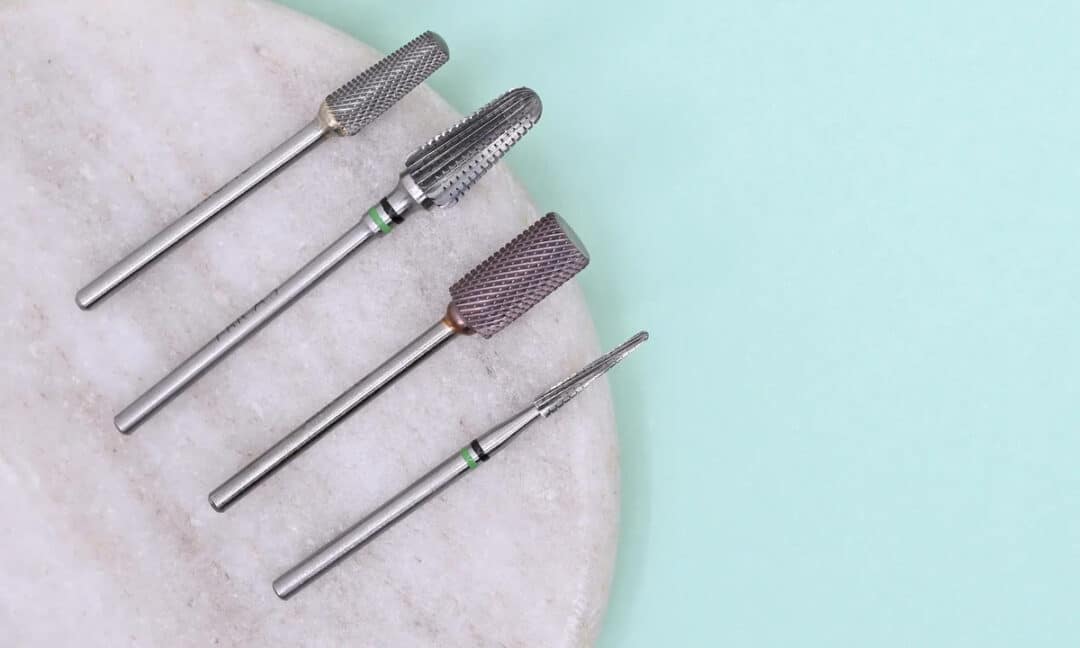
- Diamond Bits: Designed for precision work, diamond bits are commonly used for cuticle exfoliation, natural nail preparation and dry manicure techniques. Their abrasive surface consists of fine diamond particles bonded to a metal base. Different shapes and grit levels allow nail technicians to work accurately around the nail plate, cuticle area and sidewalls.
- Carbide Bits: Made from tungsten carbide, carbide bits use precisely cut flutes rather than an abrasive surface to remove product. They are highly effective for shaping, shortening and removing enhancement products such as acrylic and hard gel. Carbide bits are designed for enhancement product rather than direct use on the natural nail plate.
- Ceramic Bits: Ceramic bits are lightweight and resistant to heat transfer. Depending on their shape and grit, they can be used for product removal, shaping and refinement. As with any bit, correct speed, pressure and technique remain important.
- Sanding Bands: Sanding bands are abrasive sleeves fitted over a mandrel. They are available in different grits and may be used for selected preparation, shaping and refinement tasks. Sanding bands are generally treated as single-use items and should be replaced between clients rather than disinfected and reused.
Industry Insight: Incorrect bit selection or poor e-file technique can damage the natural nail or surrounding skin. Always choose a bit suited to the specific task and use controlled pressure rather than relying on force.
E-File Bit Shapes for Every Service
Bit shape determines where and how the cutting or abrasive surface contacts the nail.
Some of the most common shapes include:
- Barrel or Tapered Barrel: Useful for removing, shaping and refining enhancement product. Tapered versions can provide greater visibility and access around sidewalls and smaller areas.
- Cone or Flame: Commonly used for detailed cuticle work, exfoliation and accessing tighter areas around the nail.
- Needle, Nib or Pointed Bits: Designed for precise detailing in small spaces and around sidewalls or underneath enhancements, depending on the individual bit.
- Safety Bits: Feature a smooth or rounded top to reduce the risk of catching skin when working close to the cuticle area.
- Under Nail Cleaner: A specialised shape designed to refine underneath the free edge and remove excess enhancement product.
- Mandrel with Sanding Band: Provides a replaceable abrasive surface for selected shaping, preparation and refinement tasks.
No single bit is ideal for every stage of a nail service. Building a selection of shapes allows you to choose the most appropriate tool rather than trying to make one bit perform every job.
Grit Guide
Grit describes how fine or coarse an abrasive bit is.
For Erica’s ATA diamond bits, the colour system generally follows:
- Yellow, Very Fine: For highly controlled, delicate exfoliation and fine finishing work.
- Red, Fine: Suitable for gentle refinement and detailed work.
- Blue, Medium: Provides greater exfoliation or refining ability where more material needs to be removed.
- Green, Coarse: Designed for more aggressive exfoliation or refinement where appropriate.
However, colour coding is not necessarily identical across every manufacturer, so always check the specifications supplied with the individual bit rather than choosing purely by colour.
Carbide bits are also available in different levels of abrasiveness, commonly including medium and coarse options. The correct choice depends on the enhancement product, the amount of product being removed and the service being performed.
Choosing an appropriate grit allows the bit to do the work efficiently without unnecessary pressure.
2. Matching E-File Bits to Services for Maximum Efficiency
Not all e-file bits are interchangeable.
The most efficient nail technicians select their bit according to the task, product type, nail condition and the amount of material that needs to be removed.
Just as importantly, always follow the manufacturer’s recommended operating speed for the specific bit you’re using. Recommended RPM can vary significantly between different shapes, materials and applications.
Cuticle Work & Natural Nail Prep
Nail technicians commonly use diamond bits for detailed cuticle work and natural nail preparation.
A precision flame, micro taper, cone or another fine-detail diamond bit may be used depending on the technique being performed.
When working in these areas:
- Use light, controlled pressure.
- Keep the bit moving rather than remaining in one position.
- Work only on the area the bit is designed to treat.
- Follow the manufacturer’s recommended RPM range for that specific bit.
- Avoid using carbide removal bits directly on the natural nail plate.
Cuticle and natural nail work is about precision rather than speed. Increasing pressure rarely improves the result and can increase the risk of over-filing.
Product Removal
Carbide bits are particularly effective for removing enhancement products such as acrylic and hard gel.
A barrel, tapered barrel or safety smooth-top carbide can remove bulk product efficiently when used correctly.
For product removal:
- Select a grit appropriate to the amount and hardness of product being removed.
- Use the manufacturer’s recommended RPM for the specific bit.
- Keep the bit moving in smooth, controlled passes.
- Allow the flutes of the carbide bit to cut the product rather than pushing the bit into the nail.
- Reduce pressure as you approach thinner areas of remaining product.
You do not necessarily need to remove every trace of enhancement product. For example, during a rebalance or infill service, retaining a thin layer of secure existing product may be preferable to repeatedly filing down to the natural nail.
Refining Shape and Thickness
After application, e-file bits can help refine the surface, sidewalls and overall structure of an enhancement.
A tapered barrel, smaller barrel or appropriate safety bit can give the technician greater control when refining product.
Use smooth passes and regularly check the nail from different angles. The objective is to create balance and symmetry without unnecessarily thinning the enhancement.
Remember that speed and pressure work together. A well-maintained bit at the correct RPM should remove product efficiently without excessive force.
Under-Nail Cleaning & Detailing
An UNC (Under Nail Cleaner) or another appropriately shaped narrow bit can refine underneath the free edge of an enhancement.
These specialised shapes are useful for:
- Removing excess cured product from underneath an extension.
- Refining the underside of sculpted nails.
- Improving the appearance of the free edge.
- Accessing areas that a larger barrel bit cannot reach comfortably.
These are precision tools, so visibility and control are essential.
Pro Tip: Faster isn’t automatically better. Good e-file technique comes from choosing the right bit, maintaining control and allowing the tool to perform the work.
3. Safety First: Protecting Clients, Machines & Yourself
E-files can improve speed and consistency enormously, but only when they are used with good technique.
Safe e-filing protects the client’s natural nails and skin while also reducing unnecessary strain on the technician and wear on the equipment.
Avoiding Heat Spikes
Heat is generally caused by friction.
A client may experience uncomfortable heat when:
- The bit remains in one area for too long.
- Too much downward pressure is applied.
- An unsuitable bit or grit is being used for the task.
- The bit has become dull and requires additional pressure to work effectively.
- The technician repeatedly files a thin area of product.
- The chosen speed does not suit the bit, product or technique being used.
Keep the bit moving in controlled passes and allow the bit to do the cutting.
If a client reports heat or discomfort, stop immediately and reassess your speed, pressure, bit choice and technique before continuing.
Managing the Dust E-File Bits Create
Heat isn’t the only byproduct of filing. Every removal and refinement creates dust, and the particles fine enough to stay airborne are the ones that end up in your breathing zone rather than settling on the desk.
Bit choice and technique make a real difference here. A sharp bit running at its recommended speed produces noticeably less dust than a worn one being forced through product, which is another reason to replace bits before they’re truly finished.
Technique alone won’t clear the air though. WorkSafe guidance for nail technicians covers dust, ventilation and extraction alongside chemical exposure, and it’s worth a read if you’ve never gone through it. The short version: extracting dust at the desk, before it travels, does far more for you than filtering the room afterwards. That’s exactly the job a desk unit like the Saeyang Levent dust extractor is built for, it captures dust at the source and traps the fine particles in an H13 HEPA filter, rather than letting them circulate and settle.
Client Communication
Good communication is an important part of safe e-file services.
- Explain what you’re doing, particularly if the client has never experienced an e-file service before.
- Encourage clients to tell you immediately if they feel heat, discomfort or sensitivity.
- Never assume that a client remaining quiet means they are comfortable.
- Maintain good visibility around the nail and skin throughout the service.
- Use appropriate safety-shaped bits when working close to sensitive areas where they suit the task.
A professional service should feel controlled and comfortable from start to finish.
Disinfecting & Storage
Clean and disinfect reusable e-file bits properly between clients according to the bit manufacturer’s instructions and the hygiene requirements applicable to your salon or region.
A typical process includes:
- Remove visible debris using an appropriate cleaning method or brush.
- Clean the bit thoroughly using the method recommended for the particular bit, which may include manual cleaning or an ultrasonic cleaner.
- Disinfect correctly using a suitable professional disinfectant at the manufacturer’s specified concentration and contact time.
- Dry the bit completely before storing it.
- Store cleaned and disinfected bits separately from used or contaminated tools.
In our own testing and daily use, we rely on Lucas-Cide, a salon-grade disinfectant concentrate designed for exactly this job. Whatever product you choose, follow the manufacturer’s specified concentration and contact time.
Always follow the instructions supplied with both your disinfectant and your e-file bits. Excessive soaking, incorrect chemical concentration or unsuitable cleaning products may damage certain tools.
Single-use products such as sanding bands should be discarded after use and should not be disinfected for another client.
When to Replace an E-File Bit
There isn’t one universal replacement period for every e-file bit.
Lifespan depends on factors such as:
- How frequently the bit is used.
- The type of product it is used on.
- The amount of pressure applied.
- Cleaning and maintenance.
- The material and construction of the bit.
Watch for signs that a bit is no longer performing properly:
- Product removal becomes noticeably slower.
- You find yourself applying more pressure to achieve the same result.
- Cutting edges or abrasive surfaces appear worn.
- The bit becomes damaged or uneven.
- You notice unusual vibration during use.
For that reason, a professional bit should work efficiently without requiring force. If performance has noticeably deteriorated, it may be time for replacement.
4. Why Quality Matters: Investing in the Right E-File Bits
E-file bits are relatively small tools, but their quality has a direct effect on how an e-file feels, how efficiently it works and how long it lasts.
Before comparing individual bits, it helps to understand that not all “cheap” bits are the same thing. There are really three tiers on the market, and only one of them is genuinely a problem.
The Three Tiers of E-File Bits
1. Unspecified bits. These are the ones sold in bulk lots by sellers who cannot tell you what the bit is made from, what grit it is, or what speed it was designed to run at. There is no manufacturer name, no specification sheet and nobody to ask. They are cheap because none of that work was done.
The problem isn’t the price. It’s that you’re operating a tool at up to 20,000 RPM, millimetres from your client’s skin, with no idea what it was built to do. You cannot follow a recommended RPM that was never published.
2. Affordable professional bits. These are properly manufactured bits with real specifications behind them, sold at an accessible price. You can find out the material, the intended application and the recommended speed. They may not have the manufacturing consistency or the lifespan of a premium bit, and the range of shapes is usually narrower, but they are professional tools, and for a tech building a first kit or trying a shape before committing, they are a completely sensible choice.
This is the tier our Lola Lee e-file bits sit in.
3. Premium professional bits. These are manufactured to tight tolerances, with consistent grit, reliable balance at speed and published RPM ranges for every shape. They cost more because the manufacturing, testing and range development cost more. For a tech working at volume, the difference shows up in how a bit performs on its fiftieth client compared with its first.
Everything covered in this guide sits in this tier.
In other words, the line that matters isn’t cheap versus expensive. It’s specified versus unspecified. An affordable bit with a known grit and a published RPM is a professional tool. An expensive bit with neither is a gamble that happens to cost more.
What Professional-Quality Bits Give You
Whichever tier you buy at, a properly manufactured bit should offer:
- Consistent Performance: Predictable cutting or abrasive action makes controlled filing easier.
- Better Balance: A well-manufactured bit should rotate smoothly with minimal unnecessary vibration.
- Efficient Product Removal: Sharp, accurately manufactured cutting surfaces can reduce the need for excessive pressure.
- Greater Precision: Consistent shapes and grits make detailed work more predictable.
- Published Specifications: You should be able to find the material, grit, intended application and recommended RPM before you buy.
- Long-Term Value: A well-made bit that is correctly maintained can often provide better value than repeatedly replacing poor-quality alternatives.
Risks of Unspecified Bits
Bits with no identifiable manufacturer or published specification may present several problems:
- Inconsistent grit or cutting surfaces.
- Excessive vibration.
- Poor balance at higher rotational speeds.
- Faster loss of cutting efficiency.
- Inconsistent sizing or shape.
- Coatings or surfaces that deteriorate prematurely.
- No published RPM range, which matters more than most techs realise.
Expert Tip: Before you buy any e-file bit, at any price, ask four questions. What is it made from? Which grit is it? What is it designed to do? At what RPM should it run? A supplier who can answer all four is selling you a professional tool. A supplier who can answer none of them is selling you a mystery. It’s one of the reasons we stock Erica’s ATA, a professional e-file bit range developed specifically for nail technicians.
5. Becoming a Master Tech: Building Confidence With Bits
Owning professional equipment is only part of becoming confident with an e-file.
Technique develops through education, repetition and understanding exactly what each bit is designed to do.
Create a Reliable Starter Kit
Rather than buying dozens of bits immediately, begin with a small collection that covers the services you perform most frequently.
A versatile professional collection may include:
- A fine or medium diamond flame for cuticle work.
- A tapered diamond bit for detailed preparation and refinement.
- A medium carbide safety barrel for shaping and product removal.
- A coarse carbide option for efficient bulk removal where appropriate.
- An under-nail cleaner for underside refinement.
- A specialist finishing or polishing bit suited to your service menu.
Your ideal kit will depend on whether you primarily work with gel polish, builder gel, hard gel, acrylic, soft gel tips or a combination of systems.
If you’d prefer a professionally selected combination rather than choosing each bit individually, Erica’s ATA kits group complementary bits according to different nail services and techniques.
As your confidence grows, you can expand your collection according to your working style and client base.
Practice With Purpose
Simply running an e-file isn’t the same as developing good technique.
When practising:
- Use a practice hand or training tips before attempting unfamiliar techniques on a client.
- Practise controlling pressure and movement at different recommended RPM ranges.
- Pay attention to how different bits respond to different enhancement products.
- Observe your hand, wrist and body position.
- Film yourself occasionally to assess your technique and ergonomics.
- Keep track of which bits work particularly well for the services you perform most often.
The goal is to develop control and consistency rather than simply increasing speed.
Commit to Ongoing Education
E-file techniques continue to evolve as products and tools change.
Professional development may include:
- Following experienced professional educators.
- Watching manufacturer education and demonstrations.
- Attending trade shows and workshops.
- Completing practical e-file training.
- Taking brand-led certification programs and courses.
Even a small amount of regular education can sharpen your technique and introduce you to more efficient ways of working.
6. Our Top E-File Bits for Versatile, Efficient Nail Services
Once you understand the basics, building a bit collection becomes much easier.
The Erica’s ATA range includes a wide variety of diamond and carbide bits designed for specific professional nail services. Rather than looking for one bit that does everything, choose several complementary shapes that each perform their particular job well.
Here are six versatile options worth considering.


These are only a starting point. The best bit collection is one that reflects the products you use, the services you offer and the techniques you perform most frequently.
Final Thoughts: Elevate Your Nail Services With the Right Bit Strategy
E-file bits may be small, but they play a major role in the quality and efficiency of a professional nail service.
The key isn’t owning the largest collection. It’s understanding which bit to choose, what that bit is designed to do and how to use it safely and effectively.
By investing in quality tools, following manufacturer guidance, refining your technique and continuing your education, you can improve service efficiency while protecting your clients’ natural nails and delivering more consistent results.
Browse the full Erica’s ATA E-File Bit range and our Saeyang e-files, and if you’d like help choosing the right bits for the services you offer, get in touch. We’re always happy to help you build a professional e-file setup that suits the way you work.